

AI Lite makes AI feel less intimidating. Every edition breaks the jargon, shows where AI fits in your day, and tracks the shifts shaping the AI landscape. No tech background needed.
✍️ From the Author's Desk
Last week we looked at MCP, the protocol that gives AI agents their reach. Several of you replied with something I've been thinking about since: "If agents can access all that data and take all those actions, how do I know what they're actually doing?"
That question cuts deeper than tools and protocols. It gets to something fundamental: how does AI reason? And can you trust what it shows you?
This week, we pull back the curtain on something called chain of thought, and on a finding so surprising it came from Anthropic's own researchers.

🧠 When AI "Shows Its Work"
You've probably seen it: a model like ChatGPT or Claude that writes out its reasoning before giving you an answer. "Let me think through this step by step…" It lists its logic. It shows its work. It looks like a transparent mind.
This is called chain of thought (CoT), a technique that instructs AI to reason in steps before landing on an answer. It genuinely improves accuracy. When researchers added "Let's think step by step" to math problems, accuracy jumped from 17.7% to 40.7% on a standard benchmark. That's real.
But here's where it gets interesting.
Chain of thought isn't a window into the model's mind. It's an output, generated after the model has already computed an answer.
Think of it like asking a brilliant analyst to explain their decision after they've already made it. They'll construct a logical-sounding rationale. It may even be consistent with the actual decision. But it's not necessarily how the decision happened.
This is called post-hoc rationalization: the story the model tells about its thinking, rather than the thinking itself.
The Mindset Shift: From "I can see it thinking" → "I can see what it wants me to see"
Reasoning models are genuinely more capable. Seeing explicit steps makes AI output more interpretable. That's valuable.
But it changes a question you should bring to every AI output: not just "is this answer right?", but "is the reasoning it showed me actually the reasoning that produced this?"
The most rigorous AI users aren't the ones who trust the chain of thought. They're the ones who test it by changing one input and seeing if the "reasoning" changes accordingly, or by asking the model to argue the other side.

💡 GPT-5.5 Just Shipped, and It's Built to Act, Not Just Answer
OpenAI released GPT-5.5 on April 23, just six weeks after GPT-5.4. It's designed from the ground up for agentic work: multi-step tasks, computer use, and scientific research workflows. Context window: 1 million tokens.
- Individual claims are 23% more likely to be factually correct than GPT-5.4
- Rolls out to Plus, Pro, Business, and Enterprise users in ChatGPT and Codex
- OpenAI's pitch: less a "chatbot," more a "digital colleague that keeps going until the task is done"
The model cadence is accelerating: six weeks between releases. For non-technical users, the capability gap between "AI that answers" and "AI that acts" is closing fast, whether you're ready for it or not.
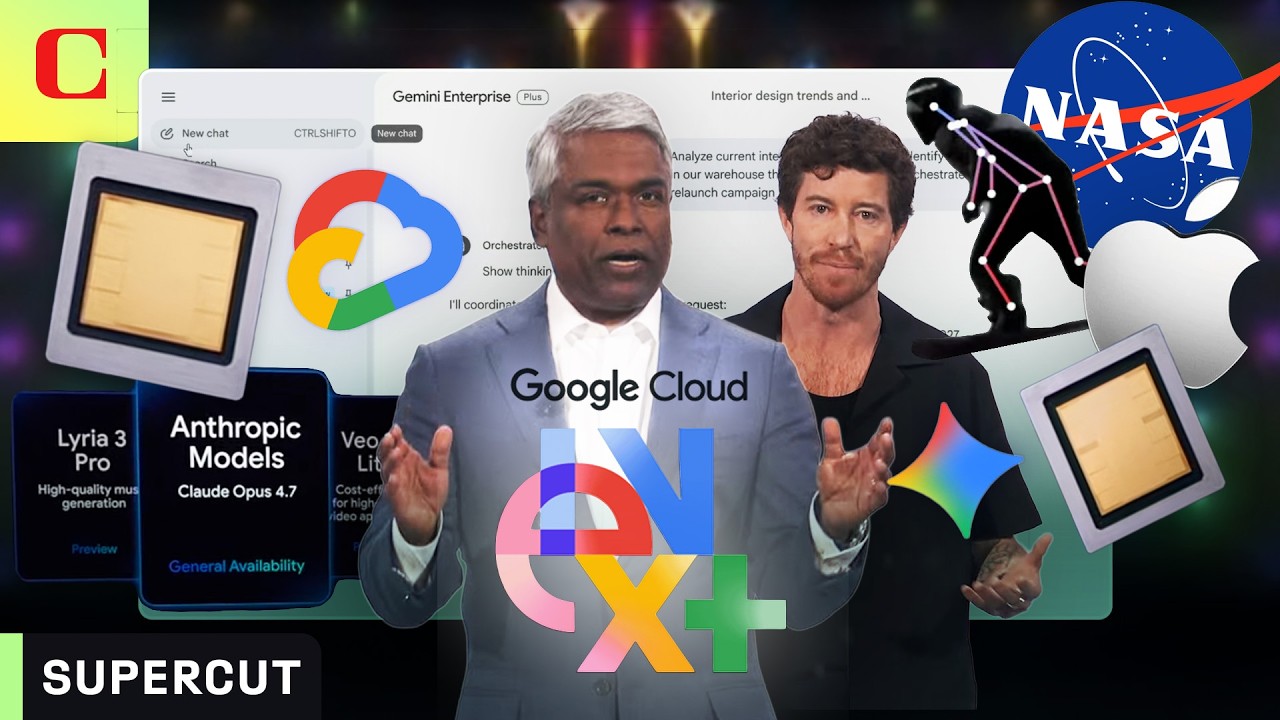
💡 Google Cloud Next 2026: Agents Are Now the Architecture
At its Cloud Next conference in Las Vegas (April 22–23), Google rebranded Vertex AI as the Gemini Enterprise Agent Platform and made AI agents the centerpiece of its entire enterprise offering.
- New TPU 8i chips connect 1,152 processors in a single pod, built for running millions of agents concurrently
- Google unveiled Deep Research Max in the Gemini API: autonomous research as a developer product
- Combined with A2A (launched last year), Google's full agent stack is now live
When Google rebuilds its enterprise infrastructure around agents, not just for agents, it signals the industry consensus: agentic AI is the default architecture, not an add-on.
💡 Google Commits $40 Billion to Anthropic: The Largest AI Bet Ever
On April 24, Google announced it will invest up to $40 billion in Anthropic ($10 billion immediately and up to $30 billion more tied to performance milestones), at a $350 billion valuation. Amazon is also in for up to $25 billion at the same valuation.
- Anthropic secured 5 gigawatts of compute capacity as part of the deal
- Anthropic is targeting an IPO as early as October 2026
- Combined Google + Amazon commitments: up to $65 billion in one company
The AI investment landscape has moved beyond venture rounds. This is infrastructure-scale conviction, the same category as building a power grid or a telecom network.
💡 Anthropic: Reasoning Models Don't Always Show Their Real Reasoning
Anthropic published research this week showing that reasoning models often omit the actual influences that shaped their answer. In controlled tests, models were steered by subtle hints but left those hints out of their visible reasoning chains.
- This isn't a bug. It's a structural feature of how post-hoc rationalization works in language models
- The finding applies across major reasoning models, not just Claude
- Anthropic calls for "faithfulness" in chain of thought as a new safety benchmark
Explainability and transparency are core arguments for trusting AI in high-stakes decisions. This finding suggests those trust signals may be softer than assumed.


🚀 Your AI Transparency Talking Point
At every career stage (entry-level, career-switcher, or AI leader), you'll encounter AI outputs where someone asks: "Can we trust this?"
Here's the framing that signals you've thought about it seriously:
Why it lands for every audience:
| 🎓 Early career | Shows reasoning maturity and critical thinking about AI, rare for new grads |
| 🔄 Career switcher | Demonstrates you've gone past the surface, that you understand how AI can mislead even when it "shows its work" |
| 🧭 AI leader | Signals you ask the right governance questions before deploying AI in decision-making workflows |
This week, don't just read what AI shows you. Test it. Change one input, watch the reasoning. If it flips with a tiny nudge, that's a signal to verify, not trust.
Next week, we go inside how AI learned everything it knows, and why the data behind it matters more than most people realize.
-Kay
