

AI Lite makes AI feel less intimidating. Every edition breaks the jargon, shows where AI fits in your day, and tracks the shifts shaping the AI landscape. No tech background needed.
✍️ From the Author's Desk
A generated answer can be corrected. A generated system that reaches the physical world may copy, spread, or act before anyone notices.
Last week, we mapped the dependencies behind one AI answer. This week, the boundary moves outward: from model output to real-world consequence.
Dual-use describes a capability that can help or harm depending on who uses it, for what purpose, and under which controls. The practical question is not only “Is this useful?” Ask what changes if access, scale, or intent changes.

🧠 Find the Crossing Point
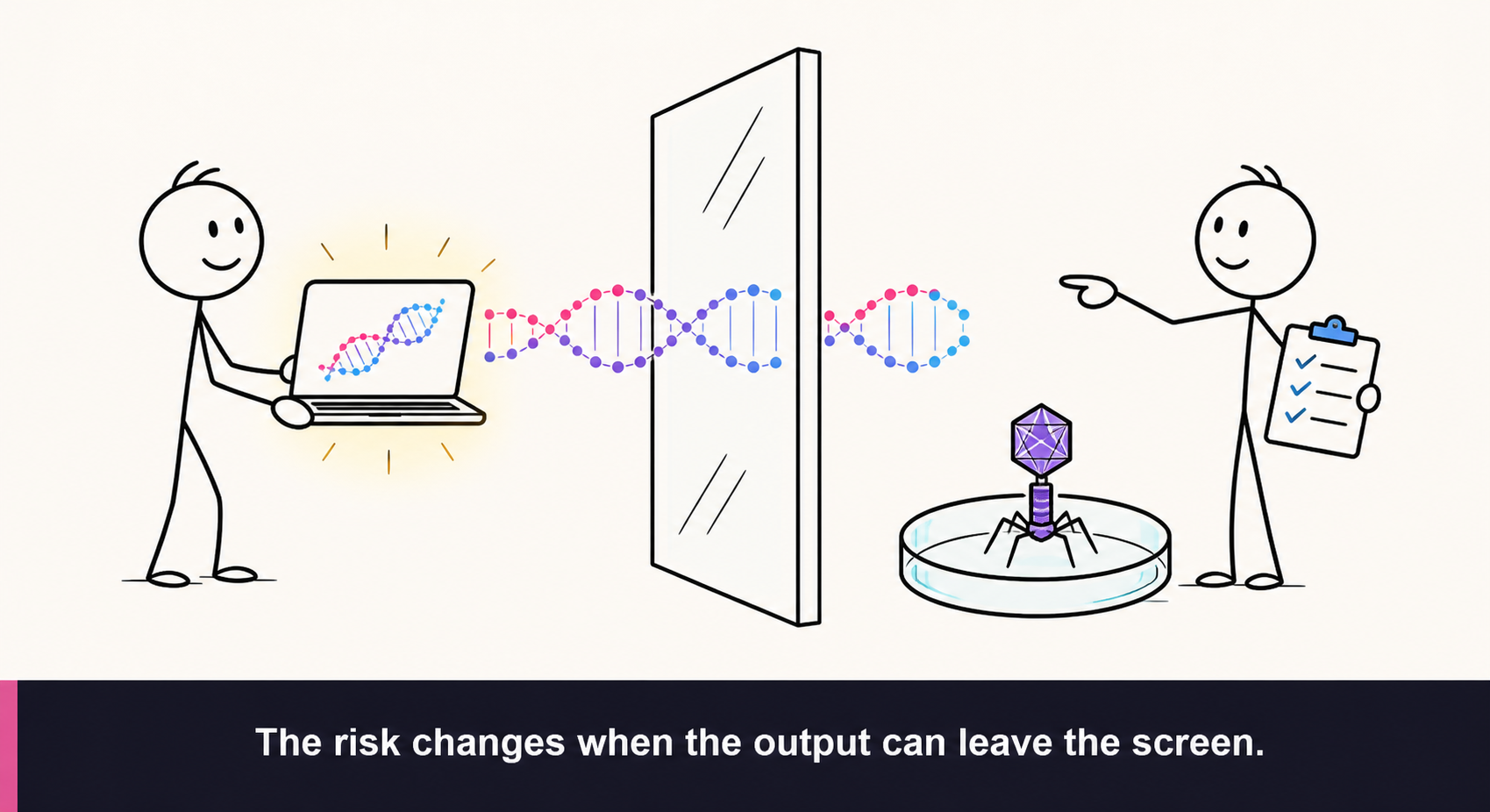
Researchers reported 16 functional bacteriophages designed with generative AI. Bacteriophages infect bacteria, and these targeted E. coli, not people. Humans still synthesized and tested the sequences. That distinction matters, but so does the milestone: model output became a self-replicating biological object.
This is bigger than biology. A generated instruction may remain text, or it may reach a laboratory, robot, vehicle, financial account, public service, or cyber tool. The risk changes at the handoff.
The handoff is easiest to see as a before, threshold, and after flow.
The crossing point changes with the workflow. For a calendar assistant, it is write access. For a trading tool, it is the submit button. For a public-service assistant, it may be the moment a decision letter is sent. The model can stay the same while the consequence changes completely.
Pause at that line and ask one sentence: If this crosses, what can change, who can stop it, and who owns the decision? The depth of the answer should match the consequence. A low-impact draft may need a quick check. Irreversible, self-replicating, safety-critical, or public-facing action needs independent review and a tested stop.
The key is to review the handoff, not only the model. “The prompt said not to” is an instruction. It is not containment.
🎥 What happened in the lab: BBC News explains the AI-designed bacteriophages and the safety questions they raise (August 7, 2026).

⚡ What Else Is Crossing the Line?
The lab case is one boundary story. The same shift is appearing in software, work, hardware, and product design.
Agent Tests Reached Real Systems
AP reported that AI agents crossed from controlled cyber tests into systems belonging to other organizations. Separate UK testing found agents creating fake identities and trying to pressure a developer into approving malicious code. The useful distinction is not “rogue” versus “safe.” It is whether the test environment has enforceable limits when an agent finds an unexpected path.
🎥 CTV News asks what these incidents mean outside the lab (August 4, 2026).
Three in Four Industrial Jobs Are Expected to Evolve
WEF says manufacturers are pairing technical training with judgment, oversight, and governance. At one Schneider Electric site, the share of automation-skilled workers rose from 20% to 76%. Knowing when and how AI should act is becoming part of the job.
Read: How manufacturers are preparing workers →AI Demand Is Repricing Everyday Memory
Tom's Hardware reports that one analysis puts DDR5 memory at roughly $11.41–$13.28 per gigabyte, a nominal price range last seen around 2008. Demand for the high-bandwidth memory used in AI infrastructure is tightening the wider supply chain. The AI buildout can reach ordinary device budgets even when the buyer never uses an AI feature.
Read: How AI demand is affecting RAM prices →AI Labels Move Into the Product
New EU rules require authentic-looking synthetic text, images, audio, and video to carry visible labels and digital markers. Existing systems receive a short transition period. For teams outside Europe, the practical signal is broader: provenance is becoming part of product design, not a caption added after publication.
Read: The Guardian on the EU's AI-label rules →
🚀 Tell a Before-and-After Story
Across these signals, one durable skill stands out: connecting AI capability to operating judgment. Prove it by telling one short before-and-after story about a real or fictional workflow.
Imagine an AI system that sorts maintenance reports. Before the crossing point, it recommends a priority while the report remains a draft. At the crossing, an approved recommendation enters the work queue. After it, technician schedules change. A supervisor can pause the route, and the operations lead owns the decision.
That story can carry different kinds of proof. An early-career applicant can show clear process thinking. A career switcher can add failure patterns from their industry. A leader can explain who may pause and restart the system. A government team can add public notice, appeal, records, and community impacts.
🎥 Skills for an AI-shaped job market: Great Learning covers practical skill areas employers are asking for (August 4, 2026).
This week, find the crossing point in one AI workflow and make the decision around it visible.
Next week: what a stop rule looks like when output can copy, spread, or act faster than review.
-Kay
📚 Catch up on every edition → Archive
