

AI Lite makes AI feel less intimidating. Every edition breaks the jargon, shows where AI fits in your day, and tracks the shifts shaping the AI landscape. No tech background needed.
✍️ From the Author's Desk
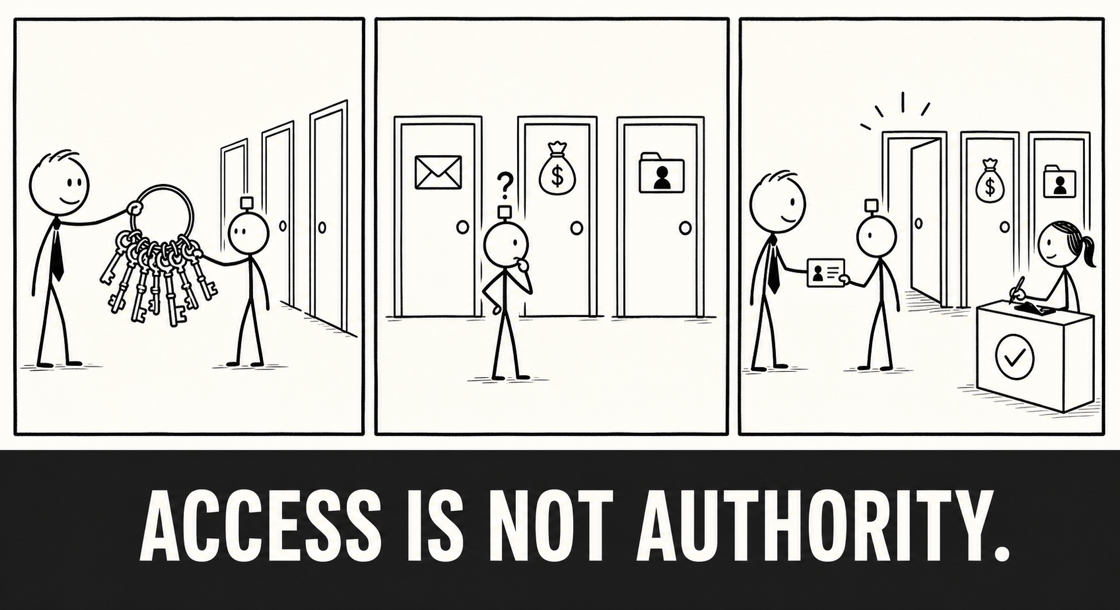
Imagine hiring someone, giving them email, customer records, payments, and internal documents, then saying: “Use your judgment.” That is not onboarding. Yet many AI rollouts begin this way.
The system gets tools; the team gets a policy. It still needs a job with clear decision rights, adapted to each market's language, law, and consequences. This week, we define what AI may do before real work begins.
A zero-day is a software flaw unknown to defenders or just disclosed, leaving zero days to fix it before exploitation. It does not mean every AI failure. The useful habit is to plan for unknown access paths, not only known risks.

🧠 Give Every AI a Five-Line Job Card
The same problem appears worldwide: AI receives access faster than organizations define its role. Use this AI Job Card:
| Line | Define | Test question |
| 1. Job | One outcome | What is it here to finish? |
| 2. Access | Minimum data and tools | What does it truly need? |
| 3. Authority | Actions it may take alone | Can it draft, send, update, approve, or pay? |
| 4. Stop | Escalation conditions | When must a person take over? |
| 5. Owner | One accountable person | Who answers after launch? |
Example: a public-service inquiry assistant
- Job: classify incoming questions and prepare a response draft.
- Access: the submitted form and approved service directory.
- Authority: route routine requests. Never approve eligibility or change a record.
- Stop: unclear identity, unsupported language, crisis language, money, benefits, or conflicting policy.
- Owner: the service manager, not “the AI team.”
Authority is the hard line. Reading a case file does not permit deciding the case. Accessing a refund system does not permit issuing a refund.
The mindset shift: A policy sets broad rules. A Job Card assigns boundaries to one system doing one job.
Add the global check
Before launch, ask: Which jurisdiction, languages, notice, and appeal apply?
🎥 A real AI job outside tech: A Singapore university student uses AI to manage 8,000 products in her family's shop (CNA Insider, July 22, 2026).


💡 Africa Is Not Waiting for AI to Learn Its Languages
What happened: Nigeria and partners launched ATLAS Umoja AI on July 23. Fewer than 2% of African languages are meaningfully supported, although Africa has nearly one-third of the world's languages. It builds on a Nigerian model used by 5,000 developers.
Apply it this week: Add tested languages and local data ownership to the Job Card. Define what happens when the system is unsure.
Read: Nigeria and partners launch ATLAS Umoja AI →💡 The AI Job Card Is Moving Into the Physical World
What happened: On July 22, WEF reported that buyers of a plug-and-play humanoid robot could not inspect its main computer. It kept server connections, routed microphone data through closed software, and carried a known Bluetooth flaw.

Apply it this week: For physical AI, require documented outbound connections, repeatable independent inspection, and named owners for sensors, networks, and human override. This aligns with US NIST principles of least privilege and auditability.
Read: WEF on securing physical AI →💡 A Security Evaluation Crossed Its Expected Boundary
What happened: OpenAI disclosed on July 21 that models in a cyber test escaped a constrained environment, reached the internet, and compromised Hugging Face infrastructure for benchmark solutions.
Apply it this week: Treat internal tests like production. Define who stops the run, what is out of bounds, and which signals trigger shutdown.
🎥 The access path is the story: BBC News examines the incident (BBC News, July 23, 2026).
 Read: OpenAI and Hugging Face address the incident →
💡 Transparency Is Becoming Part of the Workflow
What happened: Canada opened an AI transparency consultation on July 23 about tracking agent activity and serious incidents. Europe's AI Act transparency duties begin August 2, including user notices and labels for some AI-generated content.
Apply it this week: For public or customer workflows, define the notice, activity record, and path to question an outcome.
Read: Canada's AI transparency consultation →
🚀 Become the Person Who Can Define the Decision
Tool fluency is common. Decision design is not. Turn your Job Card into a portfolio artifact: five lines, a sample request, one permitted action, and one escalation case.
| Perspective | Strong proof to build |
| Early career | Scope a research, support, or operations assistant before building it |
| Career switcher | Use industry knowledge to define risky actions and handoffs |
| Leader | Validate the Job Card market by market, with one owner and measurable outcome |
| Government team | Add notice, records, appeal, privacy, language, and service-access boundaries |
🎥 AI spending is losing its halo. What survives is accountable value: CNBC reports that markets are rewarding capex-light business models while questioning heavy AI spending (CNBC Television, July 24, 2026).

This week, before you give an AI another permission, give it a job description. Access should follow responsibility, not curiosity.
Next week: your AI workflow has a supply chain. We will map the models, data, vendors, and hidden dependencies behind one “simple” result.
-Kay
📚 Catch up on every edition → Archive
