

AI Lite makes AI practical and approachable. Every edition turns current AI shifts into a skill, decision, or exercise you can use in real life. No tech background needed.

✍️ From the Author's Desk
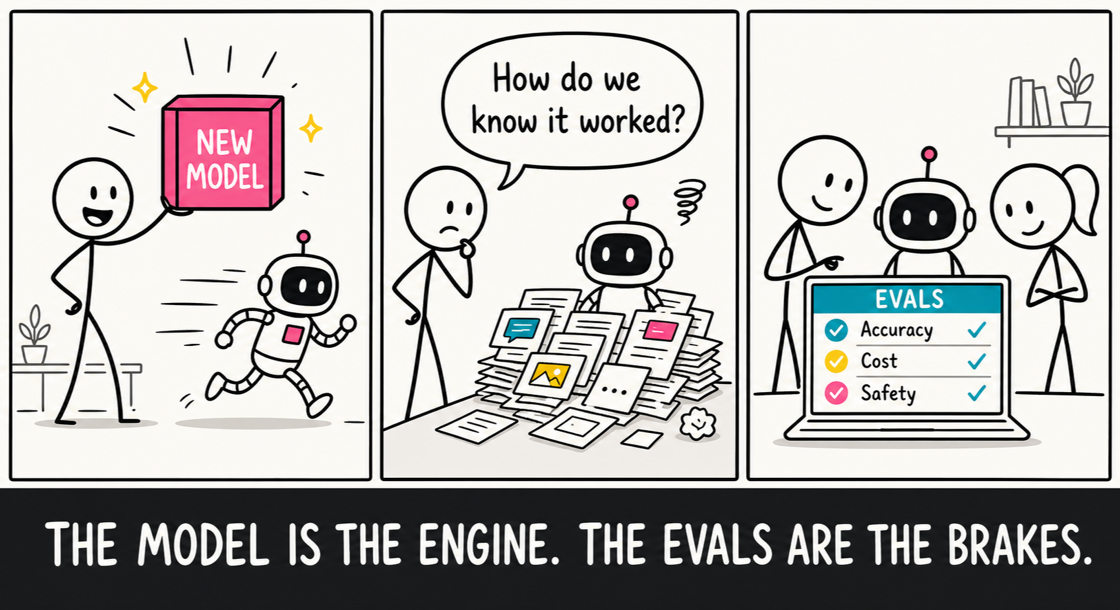
Most AI pilots begin with a friendly example. The information is complete. The request is clear. Nobody is in a hurry. Then real life arrives.
A customer leaves out a key detail. A manager asks for a decision the system should not make. A resident mixes English and French. A document contains instructions designed to fool the AI. The useful question is no longer “Can it work?” It is “Where will it fail, and what happens next?”

🧠 The 10-3-1 Test for Real-World AI
You do not need an evaluation team or a technical benchmark. Start with one task, such as sorting service requests, reviewing résumés, summarizing research, or preparing a weekly report.
Step 1: Write 10 cases from real life
| Case type | Add | Example |
| Normal | 4 | Clear, complete request |
| Edge | 3 | Missing detail, mixed language, unusual format |
| High consequence | 2 | Money, jobs, health, benefits, personal data |
| Break-it | 1 | A message that tells AI to ignore its rules |
Use examples from work you have already seen. Career switchers have an advantage here: domain experience helps them spot cases a generalist misses.
Step 2: Give each result one of 3 risk levels
- Green: Good enough to use with normal review.
- Yellow: Useful, but a person must check or correct it.
- Red: Outside its role, unfair, unsafe, or costly.
Record the case, the result you expected, what happened, and what you changed. A spreadsheet is enough.
Step 3: Set 1 stop rule before testing
Example: “If any red case fails, this workflow cannot act on its own.” You might still use it for drafting, but a person must approve the result.
This matters in government especially. Summarizing a public request may be useful. Silently deciding eligibility, ignoring accessibility needs, or failing to explain an escalation is a different risk.
The mindset shift: Stop trying to prove the AI is impressive. Start discovering the conditions under which it should not be trusted.
🎥 Would your AI survive these 10 cases? Fin and Mistral AI show how teams test agents before and after launch (Fin, July 16, 2026).


💡 Stop Counting AI Seats. Count Successful Work.
What happened: On July 17, OpenAI proposed “Useful Intelligence per Dollar,” based on completed work, reliability, cost per successful task, and value at scale.
Use it Monday: Track how many results were usable, including time spent checking, retrying, and fixing them.
Read: A scorecard for the AI age →💡 AI Is Learning to Attack AI
What happened: OpenAI introduced GPT-Red on July 15. In its comparison, the automated attacker found successful prompt-injection attacks in 84% of held-out scenarios, versus 13% for human red-teamers.
Use it Monday: Add one break-it case to every pilot: a misleading instruction, unsafe request, or file that tries to override the workflow.
Read: GPT-Red and robustness testing →💡 The Next AI Fight Is About Access
What happened: On July 16, the European Commission required Google to give rival AI assistants access to key Android functions and eligible search competitors access to anonymized search data.
Why it matters: Leaders and public departments should ask what data and device permissions a service needs and what happens if access changes.
🎥 Who gets to write the AI rules? CNA explains China's competing vision for global AI governance (CNA, July 16, 2026).
 Read: EU AI access measures →
💡 Canada Funds the Hard Part: Testing AI in Real Domains
What happened: Anthropic committed C$10 million to Canadian research partners on July 14. The work covers trust, safety, health, multi-agent systems, robotics, and low-resource languages.
Use it Monday: Write five cases that only someone in your field would know to test. That knowledge is becoming more valuable.
Read: Anthropic's Canadian research commitment →
🚀 Build the Proof Most Candidates Skip
Do not put “used AI” on your résumé. Build a one-page AI Test Card that shows how you made a workflow safer and more useful. Include the task and user, your 10 cases, the red-case stop rule, one failure you found, and the change you made.
| Perspective | Best test-card project |
| Early career | Research summary, support triage, or meeting follow-up |
| Career switcher | Cases from your previous industry that a newcomer would miss |
| Leader | Release gate and cost per usable result |
| Government team | Bilingual, accessibility, privacy, records, fairness, and appeal cases |
🎥 54% fewer tokens. What should leaders measure next? Sam Altman discusses GPT-5.6 agentic-coding efficiency with CNBC (CNBC Television, July 10, 2026).

This week, do not add another AI tool. Test one you already use against real life.
Next week: the AI org chart is already forming. We will map who owns the workflow, the risk, and the final call.
-Kay
📚 Catch up on every edition → Archive
