

AI Lite makes AI feel less intimidating. Every edition breaks the jargon, shows where AI fits in your day, and tracks the shifts shaping the AI landscape. No tech background needed.
✍️ From the Author's Desk
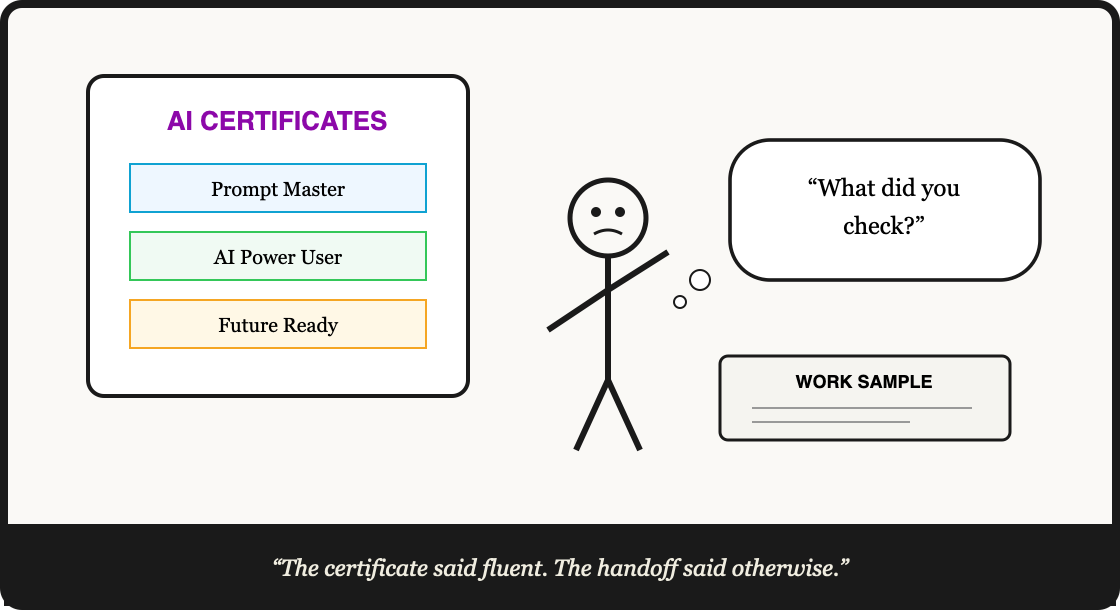
Last week, I said the first rung was gone. Then I promised the AI skill linked to 42% faster wage growth. Here is the careful version: PwC found faster wage growth in roles where AI moves people into higher-judgment work. That is a market pattern, not a personal pay guarantee.
The useful part is underneath it. The valuable skill is not prompting. It is knowing what to give AI, what to take back, and what still needs your name on it.

🧠 AI Fluency Is a Handoff Skill
Knowing one tool is temporary. Models change. Buttons move. The durable skill is managing the handoff between human judgment and machine speed.
| Handoff | Your job | Proof |
| Frame | Define the goal, context, limits, and a good result | A brief |
| Check | Test facts, logic, sources, and missing cases | Corrections |
| Own | Decide what ships and explain why | A decision note |
Most people stop after the model answers. Fluent people start there. They ask: What is missing? What could be wrong? What decision is still mine?
The mindset shift: From “I can use AI” → “I can run a reliable AI-assisted workflow.”
🎥 Watch: OpenAI Academy shows small business owners and educators learning practical AI workflows in Abilene (OpenAI, July 8, 2026).
 Read: The 5 job sectors most exposed to AI →

💡 GPT-5.6 Makes the Handoff More Important
OpenAI released GPT-5.6 on July 9. Its Sol, Terra, and Luna models target different levels of capability and cost. Sol can coordinate several agents on one complex task.
Better models can plan, use tools, and revise more of the work themselves.
Clear goals, verification, and stop rules matter more when the tool can act longer. Capability does not remove the handoff. It raises the cost of a weak one.
🎥 Fireship's first look at GPT-5.6 Sol (July 10, 2026).
 Read: GPT-5.6 announcement →
💡 Physical AI Moves From Demo to Workflow
Anthropic and UST announced a July 9 partnership to put Claude into chip, manufacturing, telecom, healthcare, and banking work. UST plans to train 20,000 people.
In chip validation, AI can read designs, write tests, compare real equipment with a digital model, and flag faults. People still approve high-stakes actions.
AI fluency is leaving the chat window. Domain knowledge is what lets you check AI where the real world pushes back.
Read: UST brings Claude to physical AI →💡 AI Agents Are Getting an Identity Check
The UN's International Telecommunication Union launched a July 9 group to create trust standards for AI agents.
The group will focus on making agents identifiable, trustworthy, and subject to meaningful human control.
When an agent can purchase, schedule, or decide, “who did this?” becomes a governance question. Good workflows need identity, permission, logs, and a person who can stop the action.
Read: UN agency launches agent trust initiative →
🚀 Build AI Fluency in 90 Days
You do not need 90 days of courses. You need 90 days of visible practice.
| Time | Focus | Proof |
| Days 1–30 | Choose one task. Write better briefs. Save examples. | Workflow map |
| Days 31–60 | Add fact, method, and edge-case checks. | Checklist and caught errors |
| Days 61–90 | Run one real project. Defend the choices. | Short case study |
By stage: Early career, use a class, volunteer, or personal project. Career switchers, apply AI inside the field you know. Leaders, define approval and failure rules. Workforce teams, assess workflows, not course completion.
🎥 Going deeper: Tech With Tim maps a career move by starting with existing strengths and closing the real skill gap (July 12, 2026).
This week, pick one repeated task and define the handoff: what AI gets, what you check, and what only you approve. Small and real beats broad and theoretical.
Next week: your AI work is becoming invisible. We will build a proof portfolio that shows what the tool did, what you did, and why the difference matters.
-Kay
