

AI Lite makes AI feel less intimidating. Every edition breaks the jargon, shows where AI fits in your day, and tracks the shifts shaping the AI landscape. No tech background needed.
✍️ From the Author's Desk
Have you opened a familiar app after an update and thought, “Why does this feel different?”
AI services can change even more quietly. The button, plan, or model name may stay the same while the system behind it changes. Your study guide becomes shorter. A product description sounds less like your brand. A meeting transcript starts missing names it caught last week.
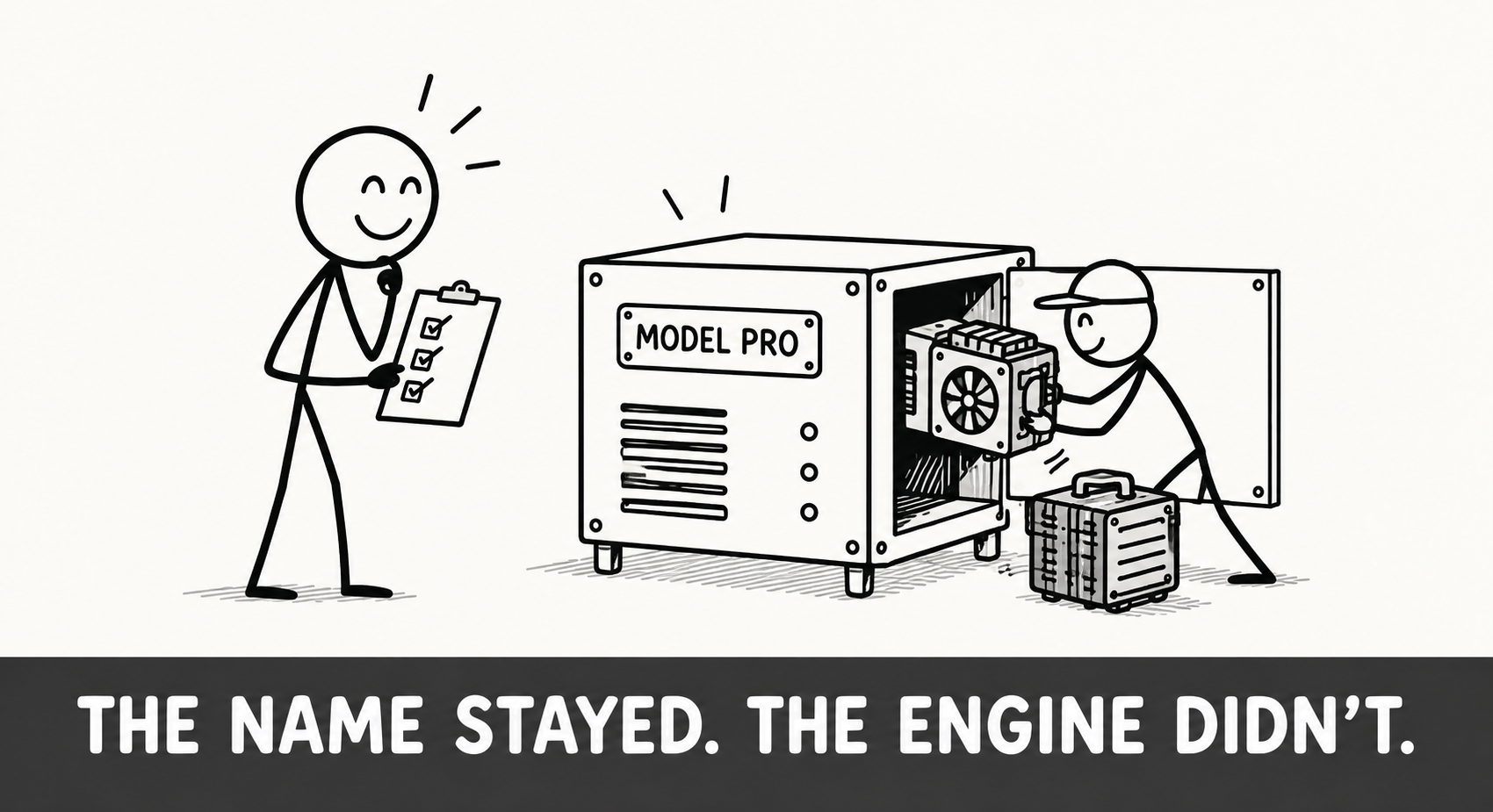
A model alias is a stable name that can point to different model versions over time. It makes upgrades easier for a provider, but the name alone does not prove which engine answered. Use a pinned version when available, and retest important work after routing changes.

🧠 Test the Service Behind the Label
DeepSeek announced V4.1-Flash on September 10. The company says the new model is faster, cheaper, and more capable than V4-Pro across its tests. The detail that matters to existing users is simpler. Starting September 14 at 04:00 UTC, requests sent to deepseek-v4-pro will route to V4.1-Flash until the next Pro model launches.
The model name in an app or script can therefore stay the same while a different model handles the request.
Think of a family using AI to plan low-cost, peanut-free meals. A new model may suggest better recipes and quietly forget the allergy rule. The same upgrade could give a student clearer explanations with fewer sources, or hand a shop faster copy that ignores its return policy. Better on average is not better for every task.
Save three requests you already use:
- one simple task, such as turning notes into a short checklist;
- one task where tone matters, such as replying to a frustrated customer;
- one task with a hard rule, such as preserving an allergy, date, source, language, or approval step.
Keep the input and the expected result. After a model notice or an output that suddenly feels different, run the same three requests again. Compare accuracy, tone, missing details, speed, and cost. If a hard rule fails, pause that use or add human review until it is fixed.
For a public-service team, the hard rule might be an accessible reading level or a correct French version. A manager may care most about a spending limit. At home it could be “do not change the medication schedule.” Match the test to the consequence.
DeepSeek’s performance and efficiency figures are company claims. Your own three-request check answers what the benchmark cannot. Does the changed service still work for you?
🎥 Watch (deeper dive): AI Coding Daily tests DeepSeek V4.1-Flash on 24 coding prompts and compares practical output quality. Published September 11, 2026.
 Read DeepSeek's announcement →

🌙 Moon Tiles Become One Reusable Model
NASA and IBM released an open-source lunar foundation model on September 10. NASA says it was trained on roughly two million image tiles from several missions and can help map craters, volcanic features, and possible polar ice.
The transferable part is the data work. When information comes from different cameras, files, or teams, align it before asking AI for an answer, and keep each source attached so a surprising pattern can be traced back.
🎥 NewsX World explains the new lunar model. Published September 10, 2026.
 Read NASA's release →
🏥 Approval Day Is Not the Finish Line
A UK commission on healthcare AI called for clearer responsibility, meaningful human oversight, and continuous monitoring after systems enter real use. Its September 10 release says performance can change as products and settings change.
Borrow that question for lower-risk tools too: who notices when the output shifts? If an AI meeting assistant begins dropping action owners, do not just repair the last summary. Record the change, tell the team, and test the next meeting.
Read the UK commission's release →🔒 Attackers Update Their Playbook Too
Anthropic’s September 10 threat report says it disrupted misuse across seven harm areas. The company observed AI being used across more of the cyberattack process, including rebuilding tools after detection.
An urgent “update,” login link, or request for a verification code deserves a second channel. Open the official app yourself, or contact the sender another way. Faster AI-assisted attacks are exactly why that thirty-second pause still pays.
Read Anthropic's report →
🚀 Build a Model-Change Watchlist
Plenty of people can use an AI tool well. Far fewer notice when one quietly changes underneath them, and that is the rarer workplace skill.
Create a small watchlist in Notes, Sheets, or your team wiki. Give each AI service you depend on one line. Write the model name, where the provider announces changes, the short task you will rerun, and who needs to hear about it if the result shifts.
For a transcription tool, use the same 60-second clip with names, dates, and one action item. A writing assistant needs one paragraph in your tone carrying a fact it must not alter. Hiring and public-service workflows should include the language, accessibility, privacy, and appeal requirements that cannot drift.
This is portfolio material because it shows judgment where a tool list only shows access. In an interview, you can say:
Canada’s National AI Literacy Initiative, announced September 9, teaches the same order. Understand AI, use it responsibly, then build with it. The program aims to reach up to one million post-secondary students and more than 50,000 educators, and that sequence works just as well for one career switcher, manager, or government team.
🎥 Going deeper: CTV News discusses the new Canadian AI literacy course and why practical understanding is urgent. Published September 9, 2026.
 Read Canada's announcement →
This week, save three real requests before the next model change saves you a surprise.
Next week, I’m looking at what an AI activity log should record before something goes wrong.
-Kay
📚 Catch up on every edition → Archive
